
 Monero (XMR) Primary · Private
 Feather Wallet Non-custodial Tor
 Bitcoin (BTC) Public ledger
 Litecoin (LTC) Public ledger
01 / Privacy comparison
Why Monero Is the Preferred Choice
Bitcoin's ledger is public. Every transaction, sender address, recipient address, amount, is permanently visible to anyone with a block explorer. Monero's ledger is not. Three protocol-level features make it structurally different, and experienced DNM community members treat that distinction as non-negotiable. Mars Market operator communications identify XMR as the primary settlement currency — the reasoning is documented in the platform overview.
Ring Signatures and RingCT
When a Monero transaction is broadcast, ring signatures mix it with a set of other transactions. An outside observer cannot determine which input is the real one; the sender is hidden among decoys selected from the existing blockchain. RingCT (Ring Confidential Transactions) extends this by concealing the amount as well. Neither sender identity nor value is linkable from chain data alone.
Stealth Addresses
Every Monero transaction routes to a freshly generated one-time address derived from the recipient's public keys. Only the recipient, holding the corresponding private key, can link that address back to their wallet. Someone watching the blockchain sees a destination that connects to nothing in their records. The recipient's reusable address never appears on-chain.
Why Bitcoin Falls Short for Privacy
Bitcoin is pseudonymous, not anonymous. The full transaction graph, every address, every amount, every connection, is public and permanent. Blockchain analytics firms run clustering algorithms against this data and regularly de-anonymise BTC payment chains, including those routed through exchanges. Bitcoin mixers and CoinJoin implementations add partial obfuscation, but they are bolt-on mitigations against a transparent base layer. Monero's privacy is native to the protocol, not layered on afterwards.
02 / What Mars Market accepts
Accepted Coins on Mars Market
Mars Market accepts three cryptocurrencies. Operator communications document XMR as the primary settlement currency. BTC and LTC are available for users who need them, with the understanding that their on-chain privacy properties are significantly weaker.
| Coin | Privacy level | Recommended? |
|---|---|---|
| Monero (XMR) |
High — native on-chain anonymity via ring signatures, RingCT, and stealth addresses | Yes — recommended by the platform and the DNM community |
| Bitcoin (BTC) |
Low without additional tools — transparent public ledger | Available; apply privacy techniques before use |
| Litecoin (LTC) |
Low — same transparent ledger model as Bitcoin | Available |
Mars Market does not require KYC for registration. Coins are accepted via walletless checkout: the platform generates a deposit address per order and no internal platform wallet is required. Before interacting with any address, verify you are on the real Mars Market, not a phishing clone.
03 / How payment works
How Walletless Checkout Works
Walletless, also called "direct payment" in Dread community discussions, means the market generates a unique invoice address for each individual order. There is no deposit-and-spend internal wallet. Funds go directly from the buyer's external wallet into escrow.
Step-by-step
- The buyer finalises an order — the system generates a unique invoice address specific to that transaction.
- Within the 30-minute payment window, the buyer sends the exact invoice amount from an external wallet.
- After the required number of network confirmations, the order status updates to Paid automatically.
- The payment enters escrow directly — it does not pass through a market-controlled hot wallet.
- The invoice address is one-time only. It is never reused for another order.
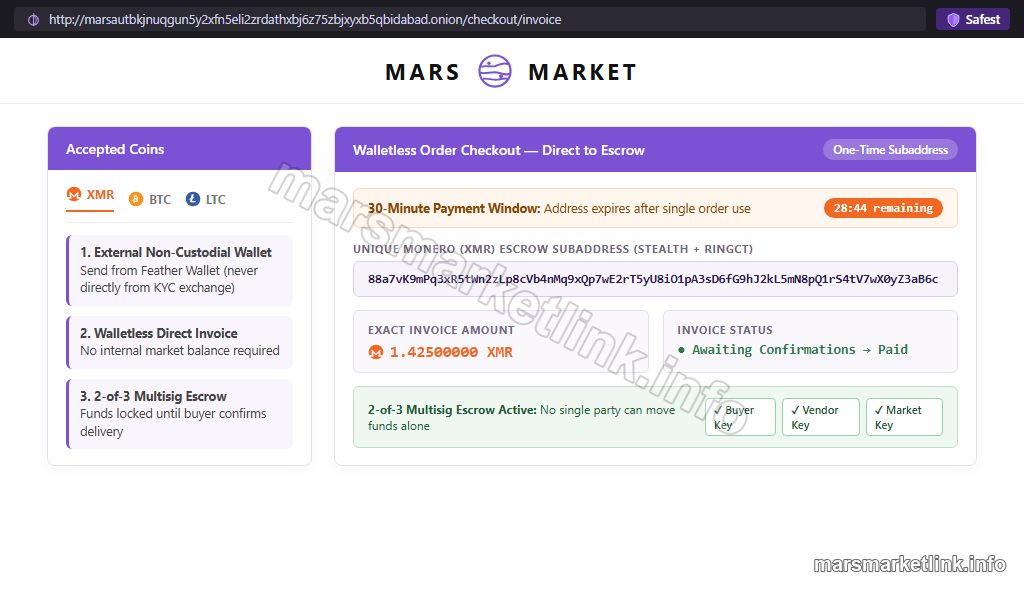
Sending directly from a custodial exchange that holds your identity creates a traceable link between your real identity and the invoice address. An intermediate non-custodial wallet breaks that connection. The full rationale for wallet isolation and intermediate wallets is in the security guide.
04 / Buyer protection
Escrow and How It Protects Buyers
Escrow is the mechanism that prevents payment before delivery from becoming the norm. The buyer pays; the market holds those funds; the vendor receives them only after the buyer confirms the order arrived. That sequence is what gives buyers meaningful leverage, and why circumventing it carries real risk.
Standard Escrow
Under standard escrow, the market holds funds between payment and order confirmation. The vendor cannot access them until the buyer marks the order received. This is the baseline protection against non-delivery — funds held in escrow cannot be released unilaterally by the vendor.
Multisig Escrow (2-of-3)
Multisig escrow uses a 2-of-3 signature structure. Three parties each hold one key: the buyer, the vendor, and the market. Moving funds requires two of the three signatures; no single party can act unilaterally. Dread community discussions call this "trustless escrow" for exactly that reason: the market's honesty is technically enforced, not assumed. Neither a compromised vendor nor a compromised market server is sufficient to drain the escrow alone.
Finalize Early (FE): When and Why It Matters
Finalize Early means releasing payment to the vendor before confirming receipt of the order. On Mars Market, FE is available only to vendors who have reached the Commander tier — the highest level in the Mars Market vendor tier system; it is not a default option. The practical consequence: once an order is finalised, whether early, manually, or through auto-finalisation, the transaction is complete and the funds are gone. There is no dispute process and no recovery path. FE skips escrow protection entirely. For any vendor without a documented track record, accepting it is a significant risk.
05 / When things go wrong
Disputes and Refunds
If an order is not fulfilled, the buyer can open a dispute, but only before the auto-finalisation timer expires. While a dispute is open, funds remain frozen in escrow. The platform's dispute system follows a time-weighted escalation model: disputes unresolved within 24 hours escalate to broader review, and those reaching 48 hours can trigger an automatic partial settlement based on the last recorded agreed delivery fraction.
A dispute requires evidence. Screenshots, tracking data, and documented communication within the platform are the materials a resolution is built on. Vendors who do not respond put themselves at a structural disadvantage; the platform's resolution process weighs available evidence, and absence of vendor response is itself a data point. For full platform rules, see the platform rules and vendor policy on the About page.
Once an order is finalised — manually, early, or through auto-finalisation — funds cannot be returned or disputed. Only finalise when the order is confirmed received.
06 / Getting started with XMR
How to Buy Monero Without KYC
The Dread and Pitch community consensus points toward P2P exchanges and decentralised exchanges as the primary route for acquiring XMR without identity verification. These platforms connect buyers and sellers directly, without a central custodian holding identification data. Among non-custodial Monero wallets, Feather Wallet comes up frequently in forum discussions: it is open-source, runs over Tor by default, and requires no account.
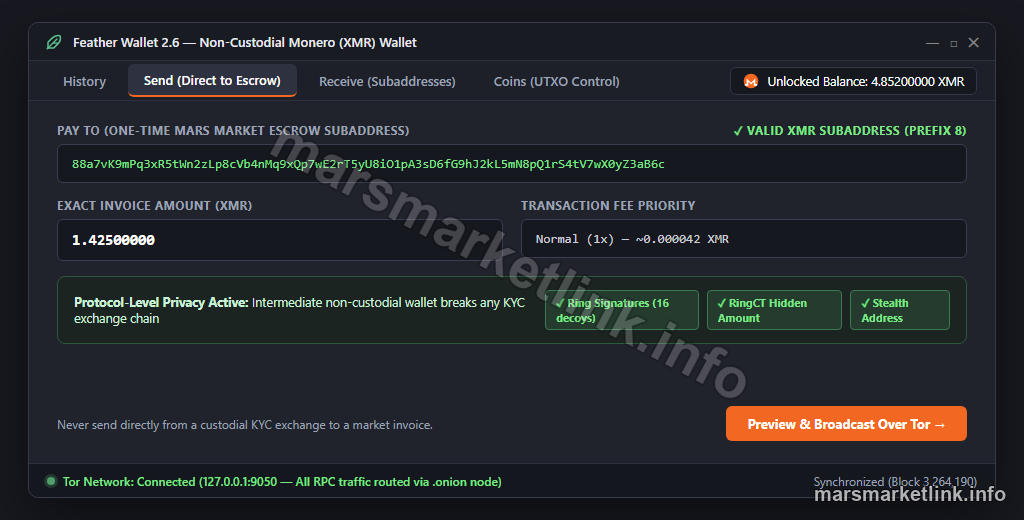
127.0.0.1:9050), never directly from a KYC exchange.
Feather Wallet · XMR
The goal is a clean separation: XMR acquired through a non-KYC route, held in a non-custodial wallet, sent from that wallet to the Mars Market invoice address. Each step in that chain reduces traceability. For detailed guidance on how to access Mars Market once the wallet setup is complete, the access guide covers the full sequence.
What comes next
Funds handled safely. Now understand the platform.
Cryptocurrency selection and escrow mechanics are covered. The remaining part of the picture is the platform itself: vendor tier rules, buyer obligations, what the dispute system actually arbitrates, and why phishing links targeting payment are the most common loss vector. All of that is in the Mars Market platform overview ↗. For the full session setup — Tor Browser, OS isolation, key storage, wallet separation — the security guide ↗ covers each layer. Verified mirrors are on the home page ↗.
Questions people ask
Quick answers
Is Monero better than Bitcoin for darknet markets?
For most use cases — yes. Monero hides sender, recipient, and amount at the protocol level through ring signatures, RingCT, and stealth addresses. Bitcoin's ledger is public; blockchain analytics firms regularly trace BTC payment chains. Without additional privacy tools, Bitcoin offers limited protection on a transparent base layer.
How long do I have to pay a Mars Market invoice?
The standard payment window is 30 minutes. The invoice address is one-time only — once the window expires, the address is no longer valid. A new order generates a new address.
Can I finalize early safely?
Only with vendors who have documented FE permission on the platform and a verified track record. Once an order is finalised — for any reason — funds cannot be recovered. FE removes escrow protection entirely. The decision should be treated as irreversible from the moment it is made.
What does "walletless" mean on Mars Market?
Mars Market generates a unique deposit address for each order. No internal platform wallet is required — the buyer sends directly from an external wallet to the invoice address, and funds go straight into escrow. The invoice address is used once and never again.